The Mineral World of John Ruskin
The Mineral World of John Ruskin
Artist
Brantwood, Coniston
Date
July 2026
Role
Conservation and Creative Lighting Design
Project Breakdown
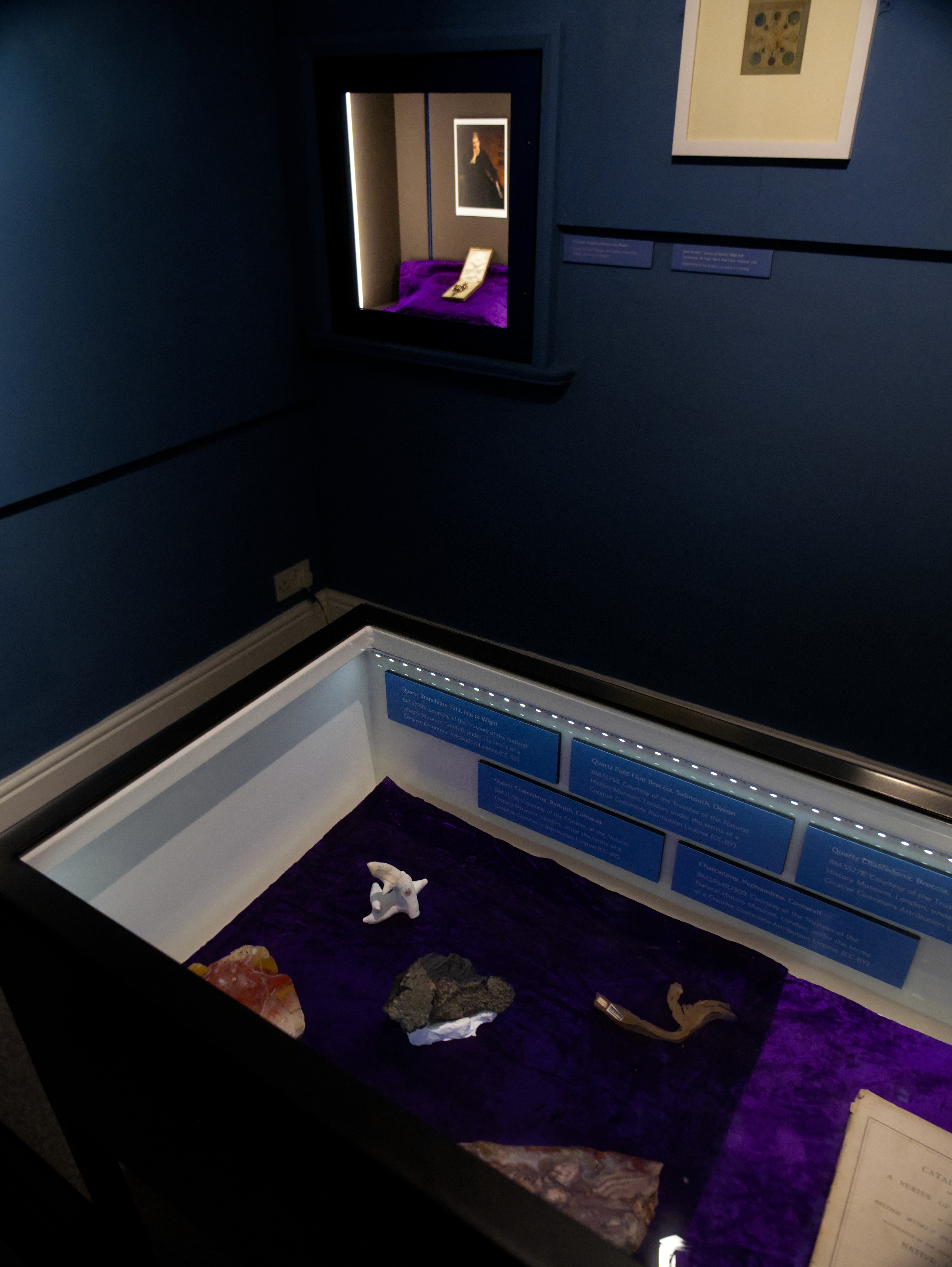
I’m very proud to present the images from the new exhibition at Brantwood, Coniston - The Mineral World of John Ruskin.
I have been really quite passionate about the topic of this exhibition since a young age, so it was fantastic to be able to spend time around the artefacts and getting the exhibition as good as I possibly could!
As ever working at very low lux levels (30 lux in this case) there is a balance to be had with contrast, adaptation from day lit spaces and getting the most out of the lighting.
When I work in museum and exhibitions spaces I always work hard to bring the magic out of them. Keeping a keen eye for shimmer, vibrancy and moments of ‘charm’ from the artwork and minerals - I’ll make many tiny tweaks to reduce glare, unwanted reflections and focus where they are needed this is always worth the effort.
I upgraded all the existing fittings by utlising a 3D printer. This allowed us to adapt the fittings towards having theatrical type adaptations, so to push the existing lighting as much as possible. This worked very well to bring the exhibition away from wide beam luminaires with little control and to bring get focus, depth and control where we wanted it. This is an exceptional way to upgrade gallery lighting systems on the lower end of the spectrum of budgets.
A big thank you to Rob Bowey and the team at UFO lighting for support in replacing some of the existing case lighting to create a fantastic display of a binded New Testament from the 12th Century treasure on loan from the John Rylands Library in Manchester. Which the end result I believe clearly met the clients request to 'make it feel like it's floating'.
*TLWS is welsh for gem/charm or purely means ‘nice’.
So the name of my practice is inspired by and manifests to create the moment you get the light or moment, just right.
About:
The exhibition runs from 3rd July – 25th October 2026 in the Blue Gallery at Brantwood and
curated by Professor Sandra Kemp, The Ruskin and Howard Hull, Brantwood.
Curatorial Description of the Exhibition:
Geology and mineralogy, rather than painting or literature, were John Ruskin’s earliest and consistent love. His father observed, ‘From boyhood he has been an artist, but he has been a geologist from infancy.
As a child growing up in London, Ruskin played in a small gravelly stream in the grounds of his house where he modelled his world in miniature. From this attention to small things he built his understanding of the world. When he was twelve, to encourage his interest, his father purchased a small set of semi-precious minerals from the dealer Daniel Crosthwaite of Keswick, Cumberland, for 5 shillings. Fifty years later, Ruskin wrote, ‘No subsequent possession had so much influence on my life.’ He became a Fellow of the Geological Society in 1840.
By the end of his life, Ruskin had built one of the largest privately owned collections of minerals in the world, the legacy of which now populates many important mineral collections today. Ruskin’s considerable knowledge of minerals was informed by the latest scientific developments. But he was also captivated by the symbolic meanings they embodied in our culture, and he pursued this in his writings and teaching. In parallel to his intellectual knowledge, he developed a personal mythology which drew richly on astrology, heraldry, folklore and art.
Exhibition Leaflet: Treasures of the Earth: The Mineral World of John Ruskin
Exhibition Reference Key: The Breastplate of the Light and Covenant of Life
Brantwood Listing: Treasures of the Earth – Brantwood
John Ruskin’s mineral collection is now split across multiple institutions and this exhibition brings some of them back to Brantwood. Special thanks to Sheffield Museums Trust (Collection of the Guild of St George), John Rylands Research Institute and Library, University of Manchester, the Natural History Museum, London and Somerville College, University of Oxford for lending works from their collections to this exhibition.
Gallery




Project Breakdown
I’m very proud to present the images from the new exhibition at Brantwood, Coniston - The Mineral World of John Ruskin.
I have been really quite passionate about the topic of this exhibition since a young age, so it was fantastic to be able to spend time around the artefacts and getting the exhibition as good as I possibly could!
As ever working at very low lux levels (30 lux in this case) there is a balance to be had with contrast, adaptation from day lit spaces and getting the most out of the lighting.
When I work in museum and exhibitions spaces I always work hard to bring the magic out of them. Keeping a keen eye for shimmer, vibrancy and moments of ‘charm’ from the artwork and minerals - I’ll make many tiny tweaks to reduce glare, unwanted reflections and focus where they are needed this is always worth the effort.
I upgraded all the existing fittings by utlising a 3D printer. This allowed us to adapt the fittings towards having theatrical type adaptations, so to push the existing lighting as much as possible. This worked very well to bring the exhibition away from wide beam luminaires with little control and to bring get focus, depth and control where we wanted it. This is an exceptional way to upgrade gallery lighting systems on the lower end of the spectrum of budgets.
A big thank you to Rob Bowey and the team at UFO lighting for support in replacing some of the existing case lighting to create a fantastic display of a binded New Testament from the 12th Century treasure on loan from the John Rylands Library in Manchester. Which the end result I believe clearly met the clients request to 'make it feel like it's floating'.
*TLWS is welsh for gem/charm or purely means ‘nice’.
So the name of my practice is inspired by and manifests to create the moment you get the light or moment, just right.
About:
The exhibition runs from 3rd July – 25th October 2026 in the Blue Gallery at Brantwood and
curated by Professor Sandra Kemp, The Ruskin and Howard Hull, Brantwood.
Curatorial Description of the Exhibition:
Geology and mineralogy, rather than painting or literature, were John Ruskin’s earliest and consistent love. His father observed, ‘From boyhood he has been an artist, but he has been a geologist from infancy.
As a child growing up in London, Ruskin played in a small gravelly stream in the grounds of his house where he modelled his world in miniature. From this attention to small things he built his understanding of the world. When he was twelve, to encourage his interest, his father purchased a small set of semi-precious minerals from the dealer Daniel Crosthwaite of Keswick, Cumberland, for 5 shillings. Fifty years later, Ruskin wrote, ‘No subsequent possession had so much influence on my life.’ He became a Fellow of the Geological Society in 1840.
By the end of his life, Ruskin had built one of the largest privately owned collections of minerals in the world, the legacy of which now populates many important mineral collections today. Ruskin’s considerable knowledge of minerals was informed by the latest scientific developments. But he was also captivated by the symbolic meanings they embodied in our culture, and he pursued this in his writings and teaching. In parallel to his intellectual knowledge, he developed a personal mythology which drew richly on astrology, heraldry, folklore and art.
Exhibition Leaflet: Treasures of the Earth: The Mineral World of John Ruskin
Exhibition Reference Key: The Breastplate of the Light and Covenant of Life
Brantwood Listing: Treasures of the Earth – Brantwood
John Ruskin’s mineral collection is now split across multiple institutions and this exhibition brings some of them back to Brantwood. Special thanks to Sheffield Museums Trust (Collection of the Guild of St George), John Rylands Research Institute and Library, University of Manchester, the Natural History Museum, London and Somerville College, University of Oxford for lending works from their collections to this exhibition.
Gallery